How vulnerable are intellectual-property provisions in trade agreements?

Original Research Week continues here in the Orangespace. I’ve been thinking a lot lately about intellectual-property provisions in trade agreements. (As have a number of other people.) We’ve gotten to a point in the global economy where it almost doesn’t make sense to keep referring to things like the Canada-EU trade agreements as free-trade agreements (Journalists: Please stop doing this). Lowering trade barriers is an increasingly minor part of these agreements, given the fact that global tariff levels are at historic lows.

As my old professor Michael Hart – who’s a bit, shall we say, zealous on the issue of free-trade – taught me back in his trade policy class, intellectual property rules in trade agreements actually restrict trade. Free trade and IP are not, in other words, the best ideological (ideational?) fit. Peter Drahos and John Braithwaite, and Susan Sell, among others, have shown that this trade-IP linkage was politically constructed, as IP industry representatives successfully argued to U.S. government officials that stronger global IP protection would help stave off declining U.S. global economic dominance. Thus we have the Office of the U.S. Trade Representative’s concern about pursuing ever-stronger global IP protection.

All this got me to thinking about the conditions that would lead to the un-making of this political bargain, especially in light of rising public interest in copyright issues. I’ve written a paper about it, which I’m presenting tomorrow to the Canadian Political Science Association. In it, I argue that the involvement of the public and Internet-related firms, with their emphasis on the importance of diffusing, not protecting, information, has the potential to upset this nearly four decade-old trade-strong IP linkage. Quoth the abstract:

Though understudied in international political economy, copyright and intellectual property (IP) have become increasingly central to the appropriation of value in global production chains; stronger IP is the bedrock of U.S. attempts to maintain global economic dominance. As digital technologies have brought individuals and telecommunications companies into direct contact with copyright laws, copyright has been politicized, capable of sparking massive worldwide protests. While traditional copyright interests continue to seek ever-stronger copyright laws and international treaties in the name of stronger “property rights,” they are increasingly being countered by those promoting “user rights.” One of the most dramatic of these protests, the January 2012 “Internet blackout” in protest of two copyright bills, occurred in the United States, ironically the foremost state proponent of stronger copyright.

Copyright’s politicization offers a useful lens through which to consider the wider issue of global norm diffusion. Its politicization threatens not only the direction of future copyright laws and treaties, but also the structure of the global political economy. This paper considers the implications of copyright’s politicization by focusing on the most recent IP treaty, the Trans-Pacific Partnership (TPP). Using historical institutionalism and analyzing the effects of copyright politicization in three key TPP countries, Canada, Mexico and the United States, it argues that the United States’ strong-copyright position will become increasingly untenable, as copyright politicization becomes increasingly ubiquitous. However, regulatory capture of key copyright and trade institutions by the copyright industries means that the trend toward stronger copyright may not reverse immediately.

In short, the dissemination side is winning the framing and public-opinion battles, while elites are becoming increasingly conflicted about whether copyright’s protection or dissemination roles should dominate.

This doesn’t mean that the U.S. government will wake up tomorrow and abandon their pro-stronger-IP position in the Trans Pacific Partnership talks (the paper’s ostensible focus). Institutions and the people in them change only gradually. But it does mean that the foundations of U.S. trade-IP policy are becoming increasingly vulnerable.

Anyway. This paper is a work in progress, so I’m sure there are several things that I’m missing or could explain better. I’m looking forward to getting feedback from the panel discussant and the audience tomorrow. And if anyone else would like to weigh in, please feel free to do so in the comments or via email at bhaggart at brocku dot ca.

Posted in CPSA paper, TPP | Tagged , , , , , | Comments Off on How vulnerable are intellectual-property provisions in trade agreements?

The Mexican Stop ACTA movement and the politicization of Mexican copyright (or, how I spent my winter vacation)

I’m at the Congress of the Humanities and the Social Sciences in Victoria, British Columbia, all this week, so now is as good a time as any to actually highlight some of the things I’ve been working on for the past year.

In late February I went to Mexico to talk with several key individuals responsible for convincing the Mexican Senate to vote unanimously to reject the Anti-Counterfeiting Trade Agreement in mid-2011. It may have been overshadowed by the January 2012 SOPA protests and the February 2012 anti-ACTA European street protests, but I think it’s easily as remarkable as these two, especially given the context. The norm of Internet freedom originated (like the Internet itself) in the U.S., and there exist a large number of strong civil-society groups in the U.S. and in Europe. Not so in Mexico, where as a few of the people I spoke to mentioned, the lack of a strong institutional champion for the Internet is an ongoing concern.

Anyway, it’s a fascinating and important story, and one with lessons for the ongoing global copyright debate, particularly in developing countries. Anyone interested in copyright/intellectual property politics, online social movements should be trying to understand how a dozen individuals managed to politicize copyright and complicate (to say the least) the designs of the Mexican (and U.S.) governments. Thanks to everyone who agreed to talk with me. If I got anything wrong, let me know at the email address at the end of this post.

The paper is available here. Here’s the abstract:

The February 2012 mass protests in Europe against the Anti-Counterfeiting Trade Agreement (ACTA) demonstrated an international increase in the political contentiousness of copyright policy. ACTA, a U.S.-led treaty among several developed countries, and Morocco and Mexico, would further strengthen international intellectual property (IP) laws, potentially negatively affecting human rights and freedom of expression.

Possibly as consequential was the Mexican Senate’s June 2011 rejection of the treaty. This not only signaled copyright’s politicization in Mexico, but also reversed the Senate’s previous pro-stronger-copyright position. As a major developing country with strong U.S. ties – the main proponent for stronger copyright – the Mexican copyright debate reveals much about the possible future of developing-country engagement on IP issues. This paper examines the factors that contributed to this rejection. It focuses particularly on the mobilization of Mexican civil society on copyright – a new development in Mexican copyright policymaking.

If you’d like to comment on the paper, which I plan to publish at some point, please feel free to make them in the comment section, or to email me at bhaggart at brocku dot ca. More to come throughout the week.

Posted in ACTA, Mexican copyright, online activism | Tagged , , , , , , , | Comments Off on The Mexican Stop ACTA movement and the politicization of Mexican copyright (or, how I spent my winter vacation)

On methodology, character assassination and Twitter (are the last two redundant?)

Exhibit 6,028 on why overexposure to Twitter makes me want to take a shower:

So on Wednesday Dwayne Winseck, a communications professor and telecoms expert at Carleton University, posted a lengthy response to a journalist’s request for a methodological clarification about a report he’d written for the Public Interest Advocacy Centre’s in the Bell-Astral merger hearings in front of the Canadian Radio-Television and Telecommunications Commission. (Disclosure: Winseck is a colleague and friend with whom I’ve shared a couple of beers.)

The reporter, one Greg O’Brien, who runs cartt.ca, a website “geared specifically towards the men and women working in the cable, radio, television and telecom industries in Canada,” questioned the methodology Winseck used to measure media concentration. This is obviously a key point in a hearing that centres on whether Bell’s takeover of Astral will unduly increase media concentration in Canada. Specifically, he wanted to know why the report didn’t use the most up-to-date measure used by the U.S. Federal Trade Commission and U.S. Department of Justice.

Winseck offered a very complete response (tl;dr: the new U.S. one isn’t an academic or universal standard, and the choice of scale didn’t change the underlying results). He also included some comments to the effect that:

I tapped out a response for you last Friday (May 17) shortly after receiving your query but then thought best to wait a few days until the proceedings in the Bell Astral case closed before sending it. Oddly, the wait was opportune because I see that Bell raised exactly the same point that you did about the HHI in its final reply yesterday (Tuesday, May 21; see Bell Final Reply, page 2).

So, good question, to be sure, and either you and Bell have great minds that think alike or there’s something else going on, but let’s put aside that unseemly prospect, at least for this post, and trust that you’ve come by your query honestly.

Not knowing the deep history of the Bell Astral case, or O’Brien’s background, I ignored the insinuation that O’Brien had been fed the question by Bell and instead focused on the substance, which was convincing and, more importantly, an honest engagement with his questioner. It was a fair question, and people can disagree about methodology. What’s not to like?

Fast forward to yesterday, when O’Brien attacks Winseck on Twitter, not just for insinuating that his question had come from Bell

@mediamorphis 2 There was and is no communication, at all, between #BellAstral and I. None. I would thank you to stop lying about that.

but on his response

.@mediamorphis 4 I think the response you published to my question is mostly utter bullshit.

.@mediamorphis 5 You want to use US gov’t standards to calculate media concentration but…

and then alleges that he cooked the results

.@mediamorphis 5a …Your paper ignored the fact those standards changed in 2010, likely b/c it didn’t support your conclusions.

.@mediamorphis 6a I think you just didn’t realize the standards had changed and you published yesterday’s tap-dance as a way out because…

.@mediamorphis 6b …if you were a decent researcher, you’d have explained all you said yesterday DIRECTLY in the paper submitted…

.@mediamorphis 6c …About why using the old #s was necessary, but you didn’t. The paper acts as if the old #s were still the standard…

.@mediamorphis 6d …And that was not addressed until your post yesterday.

From my own experience as a journalist, I know that reporters often ask questions that they’ve been suggested (or, less generously, fed) by people on the opposite side of an issue. I did it when I was working as a reporter and when I was interviewing people for my PhD. But I also know how the publication you work for has a tendency to influence the focus you put on a story. So from that POV I can sort of see how O’Brien could get his back up on being accused of bias for doing that.

That’s all, I should note, without knowing the specifics of the relationship between Winseck and O’Brien. But I like to give people the benefit of the doubt.

That said, O’Brien’s response – particularly given that it was in a public venue – was inappropriate and highly unprofessional on at least two levels.

First, so what if someone thinks you’re taking questions from an industry source? A reporter accused of bias? Grab a soother and get in line; it comes with the territory. Sometimes the accusation comes from a partisan, other times it comes from an unfamiliarity with how journalism happens. Either way, what does a reporter, whose livelihood depends on getting people to talk (and to explain things to them) have to gain from insulting someone in public? Especially someone who is likely to have knowledge or contacts that may come in handy in the future?

Would it have been so hard to smile, even through clenched teeth, say thanks (sincerely; this wasn’t the type of post you just throw together) for a substantive response and move on, instead of throwing a hissy fit that had nothing to do with the substance of the issue under discussion?

Which brings us to the second point, O’Brien’s accusation that Winseck deliberately “ignored the fact those standards changed in 2010, likely b/c it didn’t support your conclusions.” At first glance, this is really over the top, especially since
Winseck points out that the choice of scale didn’t affect his paper’s findings. Quite frankly, it also doesn’t cast O’Brien in the best light when it comes to suspicions that he may have it in for Winseck, for whatever reason.

But what’s nice about this accusation is it allows us to move from feelings and insinuations to substance. Winseck has defended his report on Twitter and in a lengthy blog post. O’Brien is accusing Winseck of ignoring the new guideline “likely b/c it didn’t support your conclusions.”

This kind of dishonesty is a serious charge, at least in academia. Winseck has given his defense, showing that this report’s findings aren’t sensitive to the choice of scale. If O’Brien is going to accuse someone of cheating, it’s incumbent on him to show how the choice of thresholds doesn’t support Winseck’s conclusions. Otherwise, if I were a cartt.ca subscriber, I’d be wondering about the quality of information I’m getting.

At the end of the day, I know this is just people behaving badly on Twitter, and criticizing it is kind of like criticizing Rob Ford for making an ass of himself. But wouldn’t it be nice if we (reporters and academics) stopped snarking on Twitter and tried focusing on substance?

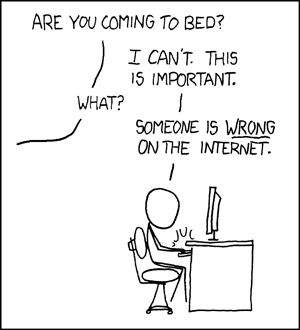
ETA: And, of course, the cartoon is from xkcd.

Posted in A futile plea for civility on teh Internets | Tagged , , | 1 Comment

Politics and Economics: The Reese’s Peanut Butter Cups of the Social Sciences

Or they should be. I’ve never understood the antipathy between the two disciplines. If you’re studying economic phenomena you better have an understanding of both their mechanics (economics) and their context (politics).

Anyway, I’m posting this mainly as a reminder to myself, because I plan to steal use this tasty quote next year when I’m introducing a new batch of students to the study of the Global Political Economy.  Cosma Shalizi on the main problem with “left neoliberalism” (via Henry Farrell; links removed):

“When you tell us that (1) the important thing is to maximize economic growth, and never mind the distributional consequences because (2) we can always redistribute through progressive taxation and welfare payments, you are assuming a miracle in step 2.”

For where is the political power to enact that taxation and redistribution, and keep it going, going to come from? A sense of noblesse oblige is too much to hope for (especially given how many of our rich people have taken lots of economics courses), and, for better or worse, voluntary concessions will no longer come from fear of revolution.

Right on!

Posted in 4P21 | Tagged , , | Comments Off on Politics and Economics: The Reese’s Peanut Butter Cups of the Social Sciences