Canada’s Access to Information Act leaves grad students out in the cold

When I get back to Ottawa in a few weeks, I have waiting for me a package of documents I requested from the Privy Council Office (PCO) about Canada’s attempts to implement the 1996 WIPO Internet treaties. I asked for them through Canada’s Access to Information process at least two years ago (if I recall correctly; it’s been so long that I figured that I wouldn’t be getting anything from them before I graduated).

Why the delay? According to the Globe and Mail, reporting on a report from the Access to Information Commissioner:

The PCO receives a “D” ranking for posting some of the longest completion times in government. The council is also causing delays for access response times in other departments, which must seek PCO’s advice on whether certain matters should be exempt as cabinet confidences.

This bottleneck is partly due to the fact that only four staff are assigned at PCO to manage the entire workload of deciding what is or is not a cabinet confidence.

At least I’m not alone.
Four staffers. It’s almost as if the government and bureaucracy don’t want to release any information. But that would be crazy talk.
As for what my wait got me, I’m not optimistic: My last information requests (they’re all back in Ottawa, so I can’t remember which departments were involved) got me a whole slew of press clippings and documents freely available on the government’s websites.
There’s a talent to filling out access requests to ensure that you get actual information in a timely(ish) manner. Simon Doyle got a fantastic book on the 2005 attempt to implement the WIPO Internet treaties out of his requests (I’ve used some of the files he received under the Access to Information Act, and his reporting will likely figure prominently in my Canadian case study), Michael Geist regularly finds some nice info, and Ken Rubin has made a career out of making access requests.
Each of these fellows, however, have one thing in common: they’ve been doing this for a long time. Doyle (whose book was based on his M.A. journalism thesis) was working as a reporter for the Hill Times, Geist has been following copyright and digital policy for over a decade as a professor at the University of Ottawa, and Rubin’s name has been showing up in newspapers for as long as I can remember.
Graduate and doctoral students (a.k.a. the people who are supposed to be producing Canada’s cutting-edge research) aren’t so lucky. Not only are they new to the research game, the time-limited nature of their research (one-to-two years for a Master’s student, three-to-four years for a PhD student) means that any information that they do get could easily show up after they’ve completed their degree.
And God forbid the researcher’s request isn’t sufficiently specific and has to re-file a request for the correct information. When a researcher has short timelines and a lot of balls in the air, the Access to Information process can be a one-shot proposition.
Either way, the government will have effectively waited out the scholar, making Access to Information requests an unreliable, if not completely useless, source for graduate and doctoral students. At least that’s been my experience.
That the very people who think about how government does and should run are stymied and often kept completely from the information they need for sound analyses should concern anyone who likes intelligent policy and accountable government. There’s something very wrong with Canada’s Access to Information regime when finding out basic information about your democratically elected and accountable government is a talent and not a right.
Students and researchers: How useful has Canada’s Access to Information regime been for your research? Have you found it as frustrating as me, or has it been a valuable source of information? Feel free to weigh in below.
Update, April 13, 2:26 p.m.: Ouch. I missed this chart, providing information-access grades for various government departments. None of the ones I’ve dealt with came off very well, except Industry (B, or “above average”): Privy Council Office (D, “below average”), Canadian Heritage (F, “unsatisfactory”) and Foreign Affairs, which apparently broke their grading scheme (off chart, “red alert”).
It looks like my big mistake was deciding to study something that touched on foreign affairs and the PCO, rather than, say Justice, and Citizenship and Immigration issues (both rated A, or “outstanding”: congratulations to those responsible for doing a hard job so well). Of course, given the centralization of power in the hands of the prime minister, is there any federal-political subject of any importance that doesn’t involve the PCO?
Posted in access to information | 1 Comment

Mexico copyright reform: Well, that was quick

Way back in November I blogged about the Coalición por el Acceso Legal a la Cultura (Coalition for Legal Access to Culture), which brought together industry and artists’ groups (actually, collection societies representing artists and various unions), the two big groups in Mexican copyright policy, to push for stronger copyright laws. I argued that this was a big deal, akin to labour and business groups getting together to argue joint positions on economic policy. While such cooperation and agreement among groups is not unusual in other countries, I was surprised by the extent to which the two sides, representing both foreign and domestic interests, seem to have fused their positions. With Mexican copyright’s two main stakeholders agreeing to try to agree, it seemed like stronger Mexican copyright laws were a good bet.

The coalition’s big demand was for authorities to be granted ex officio authority, that is, the right to make copyright-related arrests without waiting for a complaint from the party who’s copyright has been alleged to be violated. This, of course, would make it much easier and less expensive (that is, for the copyright owner) to actually enforce copyright.

Well, Alejandro at Bitácora de Darkness passes along the news that the Mexican Congress has approved amendments to Mexican copyright and intellectual property laws, as well as the Mexican penal code, to do just that, as well as increasing the fines for which violators are liable (El Universal story here). The reforms also (this is interesting) target consumers who knowingly buy bootlegged goods.

Five quick thoughts:

1. It’ll be interesting to see if the government actually uses these new powers. As anyone who’s ever been to Mexico knows, informal markets selling bootlegged goods are everywhere. Cracking down on them has the potential to create social unrest because: a) they employ a not-insignificant number of people in a country that doesn’t have the greatest track record of producing jobs; b) market runners, thanks to political and police corruption, have some pull in how laws get enforced, and can thus cause trouble; and c) in a country where almost half of the population lives below the official poverty line, authorized CDs and DVDs are unaffordable for your average consumer.

There’s also the tiny problem of where the money is going to come from to enforce these laws: last I checked, the Mexican government had its hands full dealing with a drug war and the fallout from the global economic crisis.

2. These amendments support my contention (which will feature prominently in my dissertation) that copyright has yet to become a political issue in Mexico. Or, at the very least, consumer and user groups continue to have little or no influence on the making of Mexican copyright policy.

3. The copyright industries and allied groups seem to have had the field to themselves, as it were, on this one. It will be interesting to see what will happen when Mexico gets around to implementing rules on ISP liability, which will involve them dealing with Mexico’s telecommunications industry and, therefore, the richest man in the world. That’ll be quite the heavyweight fight. (I’ll also be watching to see the extent to which academics and civil society groups get involved.)

4. On a related note, these reforms seem to be more concerned with today’s problem — physical bootlegging — than with the online future (I’m not really sure how the amendments will affect things like peer-to-peer, for example, where the suppliers are as likely to be in Sweden as Tepito). That’s another reason it’ll be fascinating to see how Mexico decides to deal with ISP liability and other digital issues. In the long run, that’s where the copyright action will be.

5. At the rate the situation is developing in Mexico, my Mexican dissertation case study will probably be out of date before I defend the damn thing. When it comes to copyright reform, obviously no one ever thinks of the lowly researcher.

Posted in Mexican copyright | Comments Off on Mexico copyright reform: Well, that was quick

Get you ACTA text, right here!

I’m editing one of my dissertation case studies so I don’t have time to look at it right now, but, for your reading pleasure, here’s a leaked copy of the text of the Anti-Counterfeiting Trade Agreement (ACTA), dated January 18 (h/t Geist).

Personally, I’m looking forward to never again writing the words “may contain” when talking about the ACTA.
Enjoy!

var gaJsHost = ((“https:” == document.location.protocol) ? “https://ssl.” : “http://www.”);
document.write(unescape(“%3Cscript src='” + gaJsHost + “google-analytics.com/ga.js’ type=’text/javascript’%3E%3C/script%3E”));

try {
var pageTracker = _gat._getTracker(“UA-11710783-1”);
pageTracker._trackPageview();
} catch(err) {}

Posted in ACTA | Comments Off on Get you ACTA text, right here!

Everyone’s a Keynesian during a snowfall

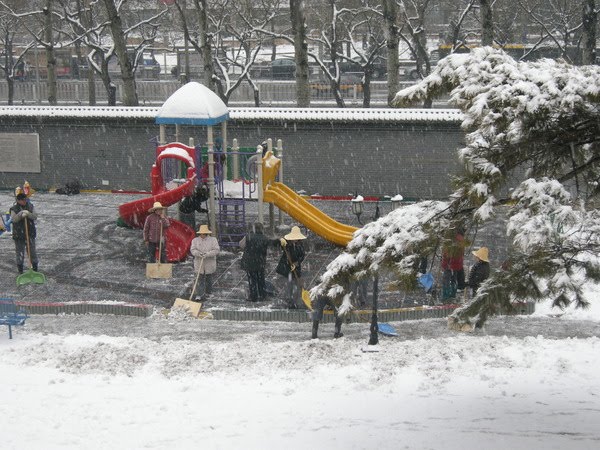
From the Globe and Mail’s Mark MacKinnon, visual evidence of how China is applying at least part of John Maynard Keynes’ advice about using government spending to stimulate the economy in a recession.

Says Keynes in the General Theory:

“To dig holes in the ground,” paid for out of savings, will increase, not only employment, but the real national dividend of useful goods and services. It is not reasonable, however, that a sensible community should be content to remain dependent on such fortuitous and often wasteful mitigations when once we understand the influences upon which effective demand depends.

Says Mark:

Because you wouldn’t believe me if I said 10 people were shovelling a small play structure (it’s snowing again in Beijing)

var gaJsHost = ((“https:” == document.location.protocol) ? “https://ssl.” : “http://www.”);
document.write(unescape(“%3Cscript src='” + gaJsHost + “google-analytics.com/ga.js’ type=’text/javascript’%3E%3C/script%3E”));

try {
var pageTracker = _gat._getTracker(“UA-11710783-1”);
pageTracker._trackPageview();
} catch(err) {}

Posted in Keynes | Comments Off on Everyone’s a Keynesian during a snowfall

Globe and Mail: Almost understanding teh Interwebs (progress!)

Credit where credit is due: After complaining a few weeks ago about Michael Valpy’s confusing story in the Globe and Mail on the political effects of Facebook, it’s nice to see Ivor Tossell’s spot-on critique of why Prime Minister Stephen Harper answering a few questions on YouTube is “not the future of democratic engagement” or “the evolution of social media,” no matter what the PMO says.

Too bad it’s paired with Roy MacGregor’s column, which is hugely enjoyable for its remarkable lack of self-awareness. His big concern is that, online:

what has come to matter more than anything else is the number of hits a certain story receives. The more hits means, in most cases, the larger the audience, and while reaching more readers and viewers is a good thing on one level, it is also a concern for those who believe journalism is about content and information more than reaction.

The potential result? A zero-sum, dystopian world in which quality journalism is strangled by the hobgoblins of celebrity gossip and partisan opinion masquerading as news. Because there’s no way that both can exist together online.

He singles out the tendency of online writers to use “hot button” words in headlines or far up in the story (maybe in the first paragraph!) in order to attract readers.

Imagine that: publishers, editors and writers choosing stories, many of dubious social value, in which they think people are interested, and then packaging those stories and writing headlines in such a way as to grab potential readers’ attention.

Readers are invited to explain how this is any different from, I don’t know, the workings of any general-interest newspaper ever.

(h/t: Susan Delacourt for pointing out the two columns.)

var gaJsHost = ((“https:” == document.location.protocol) ? “https://ssl.” : “http://www.”);
document.write(unescape(“%3Cscript src='” + gaJsHost + “google-analytics.com/ga.js’ type=’text/javascript’%3E%3C/script%3E”));

try {
var pageTracker = _gat._getTracker(“UA-11710783-1”);
pageTracker._trackPageview();
} catch(err) {}

Posted in It's the end of journalism as we know it (and I feel fine) | 1 Comment