The part of The New Knowledge (buy it, or download a free pdf here!), co-authored with Natasha Tusikov, that always seems to blow people’s minds has to do with tractors. Specifically, software-enabled, networked tractors, which we discuss in Chapter 7. Almost without fail, they’re shocked to realize that the combination of software (protected by copyright, contracts and terms of service) and network connectivity means that farmers, who often pay half a million dollars for them, don’t actually control “their” machinery.
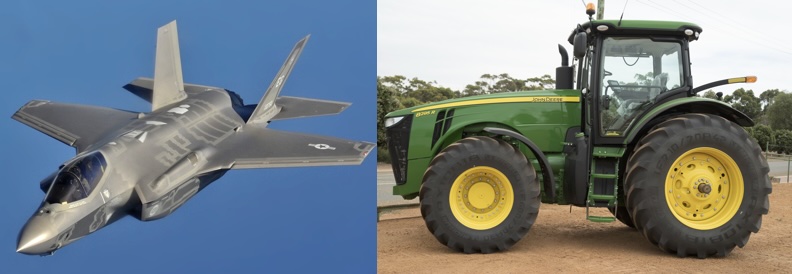
Instead, control rests with the vendor, the manufacturer, who controls the software that allows the physical machine to function. Such “post-purchase control” can be useful. For example, in the case of theft, the company can simply cut off functionality, as John Deere has done with tractors stolen in Ukraine.
But implicit in this control is that the vendor will make decisions about how the tractor will function that fit its own interests, not the farmer’s. If the vendor wants to maintain control over repair (a lucrative revenue stream), it can set restrictions in the contract/terms of service and—more importantly—set digital locks in code that prevent repair. Farmers then are prevented from repairing their tractors or even diagnosing problems with the machines, something they’ve done for decades. Point is, even if you own and are physically holding or touching a software-enabled, networked device, you don’t control it. It’s not yours.
The realization that you might not control what you own hits particularly hard because there are few things that seem more physical, more offline, than agriculture, and tractors. Except perhaps guns and fighter jets.
Understanding the full implications of software-enabled physical goods – the Internet of Things – requires a wholesale mindset change. Explaining and exploring the implications of this point was really the main reason we wrote The New Knowledge in the first place.
Whether it’s agriculture, or smart cities, or military procurement, the physical thing is now secondary to the intangible software that makes it go. This change transforms the nature of ownership, challenges fundamental definitions of property, and reshapes relationships of power and control. And, as our readers’ reactions suggest, most people still don’t fully understand how dramatically the incorporation of software in physical goods changes things.
All your jets is belong to us
At this moment, Canada is getting a crash course in the power dynamics of the Internet of Things, thanks to the Department of National Defence’s purchase of the US company Lockheed Martin’s F-35 fighter jet.
Michael Byers has criticized the purchase here. Kim Richard Nossal contextualizes our potential choices here, while David Pugilese provides some solid news coverage. As it happens, back in June Natasha wrote about the F-35 in the context of right to repair, raising many of the concerns that are currently being discussed in the context of Canadian vulnerability to US coercion.
In Natasha’s June article, she highlights how Lockheed Martin has been able to frustrate the US military’s ability to repair its equipment. To give you a sense of how tightly Lockheed Martin controls this software, Natasha notes that “the US Government Accountability Office concluded in 2023 that, without access to manufacturers’ manuals and software, military repairers ‘not only cannot fix the part, but they cannot learn and understand how to fix the part’.”
Add to this corporate power what Natasha discussed in her 2016 book Chokepoints: Global Private Regulation on the Internet: that powerful countries – like the United States – can and do coerce private companies to do their bidding to exert structural and coercive power. The whole point of the much-discussed military-industrial complex is the tight relationship between government and the military, and military contractors like Lockheed Martin. In our current moment, the problem is not just private companies price gouging militaries; it’s a hostile power that is in a position to use a company that is ultimately beholden to it as a vector of structural and coercive power.
The problem
It comes down to this: Canada is purchasing fighter jets that we will not control. Their operation will be subject to the whims and fancies of Lockheed Martin and the US government. As Byers notes, the jets will only be able to function fully via connectivity with “specialized computing facilities in the United States.” That gives the United States eyes and hands on every single thing these jets will be tasked to do.
Meanwhile, while Nossal raises concerns (correctly) about how the US might push software updates (wanted or not) that could brick the planes, that’s only part of the problem. There may be no formal “kill switch,” as DND argues in the Pugilese article, but we have to assume that the millions of lines of proprietary source code that allow the plane to function will include “backdoors” and hidden functionalities that could potentially compromise the jet’s functioning, including effectively killing it.
Imagine a “Canadian” F-35 flying a mission over Ukraine, only to find that its weapons don’t work, or all of a sudden it’s flying blind.
Geolocation’s a bitch.
In short, the problem isn’t that the US might compromise the jets at some future point. The problem is that the jets will be fundamentally compromised from the moment we take delivery.
That’s the problem. Canada may have thought it was buying cool tech or a form of interoperability with the US. That was certainly the mood in the mid-2010s among government types. In reality, as with all internet of things devices, we were setting ourselves up not to be junior partners, but for subservience. Because power rests with the vendor, not the buyer.
That’s the hard reality.
No easy answers
We have purchased fighter jets that will remain under the effective control of the United States for as long as they are in service. Which effectively gives the US a veto over our military missions, while also ensuring that our air force exists at their whim. No need to bomb an airfield to compromise a country’s air power when you can simply activate a few lines of code. Welcome to the world of the Internet of Things (read our book).
If that sounds bad, it’s because it is. So, what can we do about it?
Unfortunately, there are no easy answers. Kim Richard Nossal’s post does a good job at thinking through possible responses. He argues against cancellation, or at least full cancellation, for now. That immediately raises the question of, how bad would things have to get for Nossal to change his mind on full cancellation? My worry is: by the time things have gotten that bad, it will be too late to do anything about anything.
Unconvincing economic rationale
In the meantime, he makes a partially economic, partially pragmatic argument for keeping the F-35 (for now). Of these, the least convincing is his argument that we’ve already sunk so much into these planes that we might as well keep going. This is the sunk-cost fallacy: When you’re in a hole, keep digging.
Equally unconvincing is that we would face stiff cancellation penalties. We can think of this as an Internet of Things idiot’s tax. This is simply a variation on the sunk-cost fallacy: it fails to consider whether, just maybe, we should bite the bullet and stop digging this software-enhanced hole.
Economically, Nossal’s strongest argument is that cancelling the agreement “would bring to an end Canadian participation in the production of the F-35, with considerable costs to the defence industry in Canada, which is estimated to be worth $425 million annually and to generate 3,300 jobs annually over the next twenty-five years.”
Three things. First, Trump is already pushing Lockheed Martin to move these maintenance jobs back to the US. I would be surprised if he didn’t get his way on this one, not least because it’s good business for Lockheed Martin. Natasha’s father worked as a machinist for a US lumber company in Canada, and one of the things he learned was that it doesn’t matter how efficient your branch is, if the choice is between closing a US or a Canadian mill, the Americans will close the Canadian branch every time.
All this to say that while these numbers sound impressive, I wouldn’t count on them even if we bought the whole fleet. The economic boost for Canada will almost certainly be smaller, perhaps substantially so.
Second, these jobs will be to support a fighter jet that even its Canadian proponents (I think) realize must be retired at the earliest opportunity. In other words, they will be producing nothing of long-term value (beyond, yes, tacit knowledge, but of a proprietary nature that will not transfer perfectly to other industries). Since it’ll be tax dollars paying their salaries anyway, why not pay them to do something socially useful?
Third, if the United States is going to act as an adversary going forward, then it makes zero sense to continue to participate in the production of US military equipment that, by their very nature, can be turned against us even if we own it. This is what reducing dependency on the US looks like. What are we even talking about here?
Pragmatism and security?
So I’m not at all convinced by the economic argument for the jets. Better, but still problematic, is the pragmatic and security argument.
Which basically boils down to: we need jets, so how can we mitigate the damage caused by the fact that they will effectively be under the control of a country that wants us gone?
Nossal here has two suggestions. First, that we should cut our order in half and pivot to buying more-reliable jets from more-reliable partners. Makes sense. This changes the policy question to whether we should scrap part or all of the order? If we scrap only part of it, the security problems remain, as we’ll see.
Second, if things get really, really, really bad (what does that look like, if not Trump cutting satellite image-sharing with Ukraine?), Canada should get together with the other F-35 junior-partner countries and come up with a plan, like rewrite the plane’s source code.
An interesting idea, and I’m open to being convinced about it. But I don’t know how realistic it is. First, it would require the expertise to make such a thing viable. As Natasha’s article points out, even in the best of times, military contractors hold knowledge of how their software and machinery works close, including how to repair and mod it. They don’t share it with anyone, which puts them in a position of power, even over their own military. And that’s without mentioning the legal protections. If we’re worried about paying cancellation fees, we should also be worried about, effectively, voiding the warranty. And if it ever gets to the point where we’re no longer worried about contracts and cancellation fees, chances are the US will have already taken steps to disable or effectively destroy (in-cockpit fire, anyone?) the aircraft.
In any case, I’d want to hear from computer scientists about how challenging this would be to do in real life.
Stuck with hostile planes
As interesting as that idea is, the reality is that if we take delivery of them, we’re stuck with them, as is, software, maintenance contract, networking vulnerabilities and all. Is there a way to make that work?
There is, but we have to be realistic about what it entails. Basically, the jets would have to be confined to flying only missions that meet with the approval of the United States. This would mean they would be effectively useless in Europe, or in any area where the United States thinks Canada should not be active. We would have to accept a US veto over any international military deployments involving Canadian air power for as long as we are using these aircraft. If we buy other planes at the same time, that mitigates the problem, but we’re still stuck with half a fleet of compromised planes.
These compromised planes would have to be limited to missions the US wants us to fly. Canada’s North is an obvious candidate, as part of our NORAD obligations. One of the unspoken threads in the Canada-US relationship has always been that Canada takes care of northern North American security, such as at the border. US complaints notwithstanding, we’ve done a pretty good job of securing their northern border. This mission could be seen as part of our general North American security obligations.
It only gets worse from there. US control over our fighter jets will also give them leverage to bend us to their will in other areas – use your imagination and you’ll probably just scratch the surface – lest they monkey with our air power. In other words, giving them de facto control over our F-35s will allow them to continue extorting us in other areas of our economic, security and political relationship. If a future prime minister were given the choice between attacking Ukraine as part of a combined Russia-US force, and losing our F-35s altogether, which would they choose?
Again, it’s the modern-day equivalent of saying, give us your minerals or we’ll bomb your airfields.
The trade-off: Which bad deal do you want?
In the end, it comes down to this. If we purchased these jets, and we’re actually serious about reducing our long-term vulnerability to the United States, we would need to start working to replace them immediately. So we’re talking about a medium-term solution, at the very best.
In terms of the threat from the US, the only thing that could guarantee an invasion, even in good times, is if Canada did not keep up its side of the bargain to maintain US security at its northern border. That remains true, complicated by the fact that Trump is looking for a pretext to annex Canada, real or imagined. So, can we continue providing this air security with our current jets? And would it matter one iota if Trump decides to (continue to) take hostile actions against us? I’ll leave the first part to defence experts to judge, but we also need to consider that buying all the planes may not protect us from US ill-will.
The hard truth is, if we take delivery of these fighter jets, we will be buying jets that are under US control. This will give them a veto over what missions Canada can fly. Even more dangerously, the US will be able to use them to extort the country in other areas, military or otherwise.
I wish it were otherwise, but we have to face reality. And the reality is, with internet of things devices, power remains with the vendor. Whether it’s a tractor or an F-35, it’s all the same. If it were me, so long as Canada could fly some existing jets and fulfill Canada’s NORAD obligations, I’d cancel this agreement in a heartbeat. The downside is simply too damaging.
 Blayne Haggart's Orangespace
You must be logged in to post a comment.