
Just 30 minutes ago, I deactivated by Twitter account. This is the second time I’ve done this, but I’m pretty sure this time the breakup will be permanent. Everyone’s got their breaking point, as Gord Downie once noted. So what was mine?
Like a lot of people, my reasons for finally ditching Musk’s cesspool are political and personal. Politically and morally, I can’t justify supporting what has become an overt white-supremacist, pro-authoritarian site.
Of course, Musk’s spent the past two years burnishing his fascist, white supremacist credentials. And to my discredit, I’ve tolerated it over that time. My reasoning, or rather my rationalization, was basically careerist: as an academic, Twitter remained (and even now remains) the primary means of communication among scholars, politicians and media. When it comes to political social media, Twitter remains the dominant player.
The re-election of the nakedly authoritarian Donald Trump to the US presidency has made it impossible to maintain this hypocritical stance. Trump’s presidency will lead to needless death and suffering. It will make the world a cruder, meaner place, not least in Canada, a country of which I’m quite fond. The next several years are going to force all of us to explicitly choose to support democracy and human rights, or rank authoritarianism. This is not a time for equivocation that accords undue respect to the people, companies and forces that would destroy our democracies. I left Facebook when it was implicated in a genocide. I could hardly do less here.
My decision isn’t just high-minded. To be frank, I don’t like what Twitter, more than any other social media platform, brings out in me. One of the last things I quote-tweeted, negatively, was an editorial written by someone I knew way back when in university. Friendly, part of the same group back in the day, but we hadn’t kept in touch: that kind of relationship. I like the guy. He’s a talented writer, who just happened to have written an article in an area — Canada-US relations — in which I earned a doctorate, and whose argument I thought was completely wrong.
My response, on reflection, was pithy (thank you, Twitter character limit) but in-bounds. He sent me a DM justifying his editorial, I responded with my point of view, and that was that. We’re both adults. We both put words out there for others to consider, debate and even disagree with.
But my initial tweet still bugged me. Not that I was wrong, or even that unfair, but what am I even doing here?
Why did I care that some editorial is wrong enough to retweet it along with my own comment? Writers and reporters and editors make ridiculous pronouncements all the time. More importantly, why did I think it necessary to call out this editorial in the first place? In a medium built to generate ephemera, privileging pithiness over dialogue and deep engagement? As Emo Philips says, “I like Twitter because it combines my two favorite forms of communication: texting, and throwing a note in a bottle out into the sea.” This is not writing that’s meant to last. Short-form social media may very well be the lowest form of expression.
My reflection on my response to that editorial forced me to confront that, for me at least, my engagement with social media has been driven significantly by insecurity, a desperation to be part of the larger conversation, whatever that may be.
In my experience at least, it can be incredibly frustrating to have a deep understanding of important issues and yet not be involved in the public debate to the extent that you’d like. If you let it fester, it can eat you alive, leaving you angry and bitter. I’ve seen colleagues grapple with this dynamic.
Of course, there’s always been a well-policed academic pecking order, but social media’s promise of democratic engagement combined with its publicness makes it even worse. It turns a lot of academics into clout-chasers, begging for new followers. We become our own PR agents, promoting our latest book or article or job, always self-promoting, and trying to shove our way to the front of whatever the current debate’s about. And, of course, every time you open Twitter, or Mastodon, or Bluesky, or LinkedIn, you’re reminded that someone else is doing better than you, which feeds into a negative-reinforcing inadequacy spiral.
The reality isn’t just that people on social media tend to paint rose-coloured pictures of their lives. It’s that, no matter what we achieve, there’s always someone out there who’s doing better, or more. Constant comparison is a recipe for misery, at least in my case. I think it hits particularly hard in your fifties. I’ve heard it described that this is the decade in which you start to realize that, chances are, you won’t be able to fulfill all of your goals or realize all of your ambitions.
On reflection, what I didn’t like about Twitter, and what I don’t care for about social media in general, is how this clout-chasing, this constant comparison, this always striving to be part of other people’s conversations, had me chasing these things that, previously, I’d never really cared about.
My writing has always been almost entirely self-driven. I’ve never written out of ambition, to get a job or to win an award. I write to figure out what I think and because I love writing, in and of itself. I share my writing because it’s what you do as a writer and because I think I have something worth saying. At heart, though, it’s my art, my preferred form of self-expression.
And as for loftier ambitions, I have a healthy self-regard for the quality of my research, writing and opinions. As Max Weber noted over a century ago in Politics as a Vocation (yes, I am showing off a bit to prove my point), these are simply table stakes for all academics everywhere. Academics need to believe that their research is important, no matter what anyone else thinks. Otherwise, they wouldn’t be able to do their job.
But I have also tried to work on the principle that the best place to make a difference is wherever you happen to be. And I’m doing my best to make a difference. I’m not advising the prime minister on Canada-US relations (though I truly hope that they’re reading Kim Richard Nossal), but I do have a couple of opeds lined up and am doing regular radio interviews to highlight my concerns about Canada’s future. Most importantly, I’m organizing panels to trying to help my fellow Niagara residents and Brock colleagues understand what’s going on. And I’m talking through these issues with my students in class. Along the same lines, my book, The New Knowledge, may not revolutionize International Political Economy, but it’s a solid book that’s garnered positive responses from pretty much everyone who’s read it. That it has resonated with graduate and doctoral students has been particularly rewarding.
Those are the things I want to focus on: writing for writing’s sake, and helping out where I can. So, while I will still on Mastodon and Bluesky, and also LinkedIn, I don’t plan on engaging on them as deeply as I had on Twitter. Some people thrive in the clout-chasing environment. I’m not one of them. And while it has its advantages, using Twitter has been a surefire way to eventually make myself miserable and to distract myself from the joys of doing the work.
I have to say, it feels pretty great to be finally rid of it.
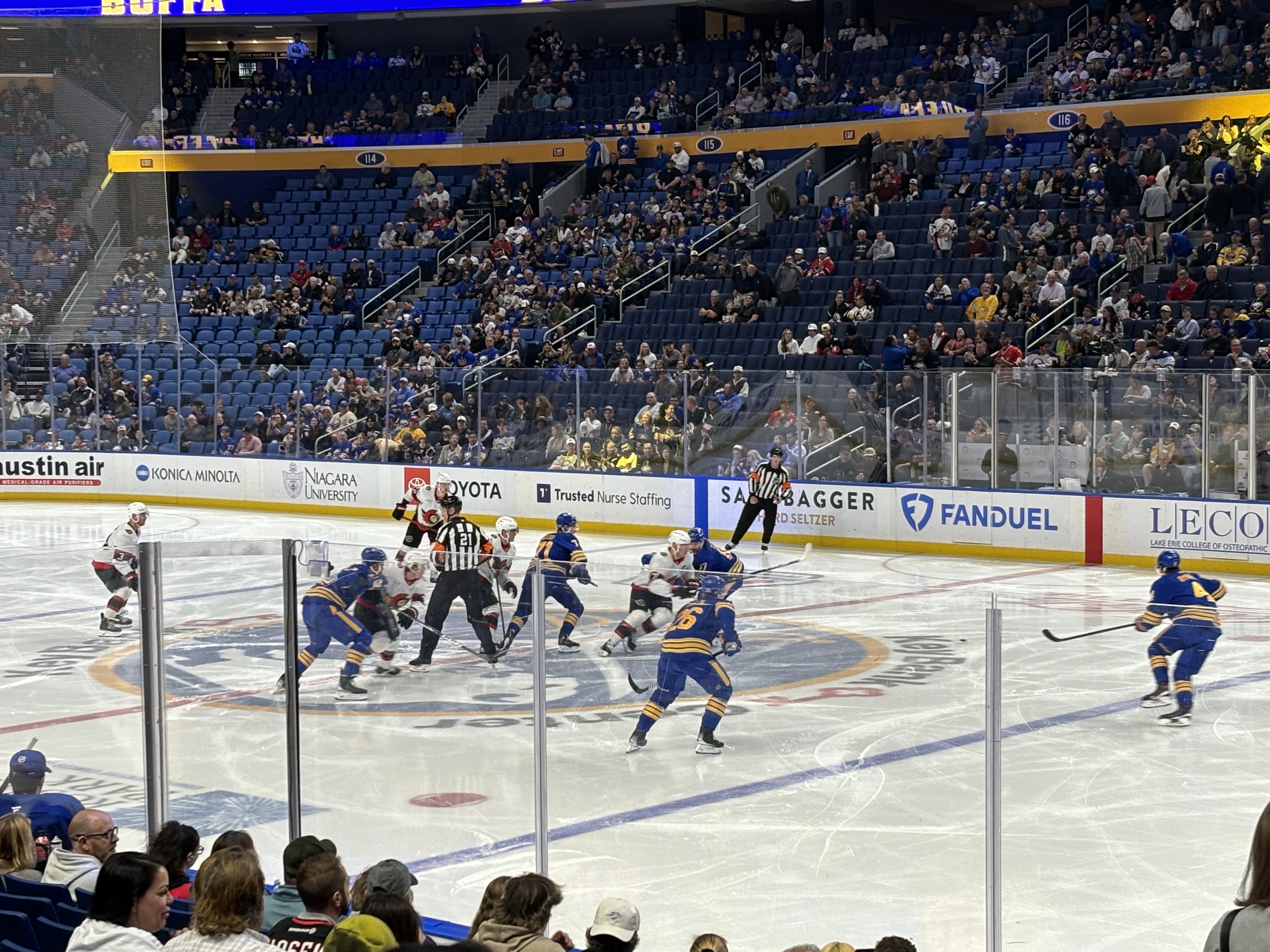
(I spent Election Night in Buffalo watching the Sabres dismantle the Senators. In retrospect, it was definitely the smart move. Sabres: Exciting team, and the tickets cost a quarter of what you’d pay in Toronto.)
 Blayne Haggart's Orangespace
You must be logged in to post a comment.